United KingdomSri Chinmoy Marathon Team

  • About us
  • Our races
  • Results

Search form

Founded by Sri Chinmoy in 1977, the Marathon Team is one of the world's largest organisers of endurance events.
read more »

Our History

Stories from the archives

Inspiration

Things that encourage us!

Sri Chinmoy

Marathon Team Founder

Training tips

From our members

Next Event:

2 August - Bristol
Sri Chinmoy Tri Club's SBR-Mini DUATHLON (run-...
Details »

More events:

Bristol
Cambridge
Edinburgh
London
Oxford
Perth (Scotland)
View all events »

Worldwide:

View full list »

Latest results:

21 July - London
Battersea Relay Teams 2026
Details »

Previous races

View all results »

Worldwide results

Full list »

Other Articles - Contents Page

By Garga Chamberlain
15 November

Inspirational Quotations on Running

The London to Brighton Runs - a Sri Chinmoy AC Legend?

Beginner's Guide to Fell Running

Beginner's Guide to Fell Racing

Beginner's Guide to Ultradistance Running

Inspiration - more articles

70th Anniversary of First Sub-Four Minute Mile

By Tejvan Pettinger author bio »
7 May

About the author:

Tejvan organises short-distance running and cycling races for the Sri Chinmoy Marathon Team in his home city of Oxford. He is also a very good cyclist, having won the National hill climb championships in 2013 and finished 3rd in the National 100 Mile Time Trials in 2014.

For many years, scientists debated whether a sub-four-minute mile was humanly possible. For decades, the goal remained elusive but on the 6th May 1954, Roger Bannister broke the magic milestone with a time of 3:59:4 on Iffley Track, Oxford. It was one of the most iconic sporting records and achievements. Interestingly after Roger Bannister broke the four-minute mile, quite a few other runners started to break the invisible barrier. Australian John Landy lowered the mark to 3 mins 58.0sec just six weeks after Bannister. The current record is held by Hicham El Guerrouj in a time of 3:43.13.

Self-Transcendence

Often things can seem impossible to the mind, but when a pioneer breaks a record or achieves something entirely new, it gives us the confidence to follow in their footsteps.

"If we believe in our own
Self-transcendence-task
Then there can be
No unreachable goal."

- Sri Chinmoy

Sri Chinmoy often referred to his philosophy of self-transcendence - the belief and faith that we can try and go beyond self-imposed limits and achieve something new.

70th Anniversary - 6th May 2024

Earlier in the day, there had been public races in Oxford to mark the occasion; including a replica one mile race on the Iffley track. Three runners went under 4 minutes.

Our first two-mile race of the season was on the 6th of May 2024, which happened to be the 70th anniversary of this iconic record.

Video of 2 Mile Race, plus Short Archive footage of Roger Bannister

Sri Chinmoy on the Four-Minute Mile

"One mile in under four minutes was a dream, and Roger Bannister manifested the dream. Now, how many people have run a mile in under four minutes? Someone has run in 3:44. When Roger Bannister ran in just under four minutes, the whole world adored him. Now someone has run two miles in under eight minutes. It is unimaginable! Like that we can do many things."

Excerpt from "My Prophecy"

Related

  • Results from the race
  • Quote from "No Unreachable Goal" by Sri Chinmoy
View full article »

Staying Fit into Old Age - Centenarian Decathlon

By Tejvan Pettinger author bio »
3 May

About the author:

Tejvan organises short-distance running and cycling races for the Sri Chinmoy Marathon Team in his home city of Oxford. He is also a very good cyclist, having won the National hill climb championships in 2013 and finished 3rd in the National 100 Mile Time Trials in 2014.

I have a new fitness goal – training for the “Centenarian Decathlon” – i.e be fit when you are really old. The idea is that as we get older, our muscle and fitness declines rapidly. It means we can spend the last 10 years of our life, unable to move properly. The body fails before the heart and brain. The only way to be fit and mobile in the last decade of our life is to start training for it now.

The idea of a Centenarian Decathlon comes from Peter Attia – a doctor and fitness guru, who has spent a lot of time researching how to combat ageing and improve our healthy lifespan. He wrote a good book – “Outlive” which goes into different aspects of things that make a difference in improving life-expectancy and healthy life expectancy. An important conclusion from all his scientific research is that if you did one single thing to improve life and healthy life-expectancy – it is exercise. Exercise is the single most important thing that makes a difference. Try to eat healthy, get good sleep, minimise stress and cultivate happiness.  But, if there is a magic bullet, it is exercise – aerobic, VO2 max and core strength.

The great thing about this book is that it really resonated with the philosophy of my spiritual teacher Sri Chinmoy. Sri Chinmoy valued physical fitness as it enables us to a have more rounded, fulfilling life.

"Physical fitness is of paramount importance. We are not practising sports to be the world’s greatest runner or athlete. We are praying to God to keep our body physically fit so that early in the morning we can pray and meditate and begin our day’s journey with a prayerful heart. If we do not do sports and take exercise to keep the body fit, then we may become weak and sickly and suffer from all kinds of pains and ailments." Sri Chinmoy answers, part 2, Agni Press, 1995

I remember Sri Chinmoy once said that once you are over 50 you should try and if possible do 2-3 hours of exercise and stretching per day. In this regard, Sri Chinmoy definitely practised what he preached. He himself would take regular exercise and stretching to keep fit.

"Physical fitness is of paramount importance. Do whatever exercise you want to, as long as you do something. I take daily at least two hours' exercise, sometimes two and a half, sometimes three. Usually, I do it at three different times during the day. Even at night, before I go to bed, I have some special exercises that I take." - Sri Chinmoy, Inner Meaning of Sport

When Sri Chinmoy was young, in India he was an excellent sprinter and decathlon champion. When he came to the West, he took up distance running. Unfortunately, as many of us will relate to, he experienced bad knee pain, which forced him to stop running. But, he never used this as an excuse to stop exercising. He would walk or exercise with weights. In his mid-70s, Sri Chinmoy was still active in weightlifting. I remember watching Sri Chinmoy walk painfully to a lifting apparatus and then use the parts of his body which could take the strain. Injury was never an excuse. In fact, in one tv interview, Sri Chinmoy explained his philosophy was to try and inspire people of his generation.

The idea of 2-3 hours per day exercise seems such a long-time. But, now I’m getting closer to 50, I have a goal to do this. And the thing is that to do 2-3 hours of exercise a day, you don't have to spend 2-3 hours in a gym. Try stand on one leg with your eyes closed! It's not as easy as it sounds. When waiting in a queue, you can do single leg exercises and stretches. Passes the time in a constructive way. Also, to create a time, I took to speed walking to the supermarket. Carrying shopping on back, is all good training.

Age is in the mind

In addition to training for old age, it is also worth trying to bear in mind, the philosophy "Age is in the mind - not the body" Sri Chinmoy's approach was always to imagine ourselves as young, not old.

Age is in the mind; age is not in the body. When we think that we are old, that is the end, the very end, of our journey. Every day at every moment only think that you are a seven-year-old or a nine-year-old or ten-year-old, but do not think that you are over thirty." Sri Chinmoy, Sri Chinmoy answers, part 35, Agni Press, 2004

Healthy Life-expectancy

Despite improvements in medicine we risk seeing a decline in healthy life expectancy through poor diet and exercise.

By the way, healthy life-expectancy is the age at which we are physically able to live an active life. The way modern medicine and health systems are set up – we focus a lot of effort on treating the symptoms of ill-health (and old age), but do very little on preventative medicine.  But, we can definitely start now to improve our strength and fitness which is probably the best preventative medicine.

Vo2 Max

The good news for keen cyclists. VO2 max is one of the most reliable guides to life expectancy. The higher the VO2, there is a very strong correlation for higher life-expectancy. Even small amounts of high intensity training, can boost our VO2 max and our fitness. VO2 max steadily declines with age, but we can partly arrest the decline through training VO2 max specifically. In my own cycling, this year I haven’t done very much VO2 max efforts at all, just pottering around town. So this is a good reminder to make more of an effort in this regard.

Aerobic Base

As you might expect the more you improve your aerobic base, the more good things happen for our health. It improves our cardiovascular health, but also our general mood and feeling of well-being.

The Harvard professor in this video is very good. One of the most interesting things I learnt was when people are unfit, if they exercise they don’t get the same ‘buzz’ / ‘dopamine’ effect that trained athletes do. This is why unfit people don’t like exercise, it is just all suffering, little reward. But, when you get to a certain level of fitness, then increasingly the body is able to send a reward of ‘dopamine’ and exercise becomes much more enjoyable. This is why it can be so hard to get going with exercise; at the start, it is not much fun. But, if you can get a critical mass of fitness then everything becomes easier because exercise itself becomes more enjoyable. I’ve found that in my own exercise cycles. When you’re fit and firing on all cylinders, you can’t wait to get back on the bike and do more training. But, when you get out of the habit, the idea of doing hill intervals or whatever, appears less desirable.

Core strength

Another really important thing about training for old age is general all-round strength. As a cyclist, I have often been guilty of focusing only on cycling and not doing the more ‘boring’ core strength exercises. My body type is perfect for long-seated hill climbs. But, equally, it is  unsuited for doing pull-ups and push ups. Yet, when you get really old, this kind of upper-body strength could be the difference between pulling yourself out of bed and being bedridden. I spend some time with a friend with Parkinson’s. When it kicks in, the legs stop working and to get out of bed, it requires pulling on bars to get up. It is touch and go, and this is a real motivation for training for old age. You realise every workout and muscle strength you developed – makes the difference of whether you can get out of bed, and being able to do basic tasks. There are also other exercises you can do in small confined spaces. I’m a big fan of eccentrics. Pretty much all using your body weight. The aim is to try and exercise all 600+ muscles in the body. The exercises seem easy, but the first time I did a 30 minute session, I couldn’t believe how stiff I was the next day! Muscles you don’t use in daily life.

Modern life

In the pandemic period, I got into the habit of online shopping. It’s amazing, you click on your computer and all your heavy shopping gets brought to your door. It saves so much effort. I used to take a rucksack when travelling, but now replace it with mini suitcases on wheels. Rather than take the stairs at the airport, we have lifts and travellators. Everything is geared towards comfort and ease of use. When we put a backpack on, it is a bit uncomfortable, so we seek ways to avoid lifting and carrying. Everything that used to keep the body in shape is being replaced by technology which does the heavy lifting for us. But, actually walking with a heavy backpack, is really good training for the body. It is why the army use this kind of training.

All this is good in the short-term, but it means the modern homeo sapiens is losing strength and the ability to function like we are supposed to. When things go wrong, it’s either too late or we just seek a solution to the problem of a weak body – not address the underlying cause. This is why we have to make so much conscious effort to keep the body active and avoid the comfort delusion. For example, when my 70-year-old mother brings in the shopping, I feel the right thing to do is go and help her carry the heavy shopping bags. But, actually, that weight training of lifting heavy shopping is the best thing she can do. She isn't always convinced at my logic!

On average I spend one hour a day cycling around Oxford, Kennington, mostly on the cycle path. It’s a really efficient way to both get around time, save money and keep fit.  So that’s a start, but I need to work on improving upper body strength too.


View full article »

Surfing the Line: a new documentary featuring SCMT's own Tejvan Pettinger

By Nirbhasa Magee author bio »
4 November

About the author:

Nirbhasa is from Ireland. He is an enthusiastic multi-day runner, having completed four times the Sri Chinmoy Self-Transcendence 3100 Mile Race - the longest race in the world.

Hill climbs are one of the two main disciplines in the UK amateur cycling calendar (the other being time trials). To mark the 2021 British National Hill Climb championships at the beginning of October, a new documentary by Maciek Tomiczek celebrating the world of hill climbing was released called Surfing The Line. Among other cycling luminaries, the documentary features extensive interview and cycling footage of our very own Tejvan Pettinger, the 2013 winner of the British National Hill Climb championships. Here is an excerpt from Tejvan's interview:

The way i think of it is, we are much more than the body. The mind, the body, the heart and the soul. The mind and the body can be suffering, but there is another part of you, the soul, or whatever you want to call it, that is getting great joy… And for me, its also a way to experience some kind of self-enquiry, to learn more about this deeper part of ourself.


View full article »

An inspiring tale of perserverance from our 24-hour race

By Nirbhasa Magee author bio »
27 September

About the author:

Nirbhasa is from Ireland. He is an enthusiastic multi-day runner, having completed four times the Sri Chinmoy Self-Transcendence 3100 Mile Race - the longest race in the world.

For a 24-hour race, 100 miles is considered a very respectable result for the average runner! Author and ultrarunner Adharanand Finn set out to do just that in our 24 hour race, held in Battersea, London. His story of perseverance makes for very inspiring reading, regardless of whether you are a top-level ultrarunner or just a beginner. Here is a small extract:


As the hours ticked by I started to make calculations in my head. I hadn’t set out with a pace plan. I had just trusted that if I got into my zone and kept running, I’d make it to 100 miles. I felt that as long as I kept my head together, then I’d do it.

adharanand-running.jpgBut around 17 hours in I could feel it slipping away. I was just about making four miles per hour at that point. Some hours were better than others, as I rode the moments of doubt, just about managing to stop myself tipping over the edge of the cliff. I could see other people gone. Just like me last time, they had their jackets on and were making their way around at a painful shuffle. Others were lapping like machines, incessantly strong, passing me again and again. How were they doing it? It seemed impossible to be that focussed, that physically capable after so many hours.

I had moments of uplift too. Out of nowhere I adopted a mantra: “I feel no pain. I feel only joy.” It sounds cheesy now, perhaps, but in the heat of the moment, it was incredibly powerful. I’d look up at the city skyline and repeat it over and over, and the pain went. It really did. And for a few laps - sometimes even four or five laps - I’d feel almost euphoric. I was still only shuffling along, but I was running. 

Read the rest of the story here »


Adharanand has written three great books on ultrarunning, contributed numerous articles to the Guardian and other publications, and hosts his own podcast called The Way of the Runner. You can find out more on his website...


View full article »

Three Things I Have Learned About Ultra-Running

By Suswara Payne
17 June

I remember my first ultra-run. It was with a group of friends who had decided to run from London to Brighton. Our course was about 50 miles. The furthest I had ever run before that was a marathon. It felt like a big jump - almost double the distance. It was a step into the unknown. I had no idea if I would be able to do it or what I would experience.

I was fortunate that the group contained some experienced ultra-runners who had already covered this kind of distance (and much longer) many times. But the other half of the group were newbies, like me. Looking back on it, it was the perfect introduction. It was not a race, it was relaxed. There was no pressure to keep to a particular pace, we had lots of breaks (including a picnic!), it was a beautiful route through some charming villages, and most importantly it was a lot of fun! Of course it did get more and more difficult, but we all pulled together and everyone finished.

I felt a real sense of achievement because I wasn't sure whether I would be able to complete it. Afterwards, travelling back in the car it suddenly hit me. This was a really long way - it was even taking a long time by car on the motorway! We ran that whole way. Wow!

This is the thrill of ultra-running. You can do so much more than you think you can. You can go beyond your limits. We all limit ourselves. We tell ourselves that we can do this and can't do that. We create boundaries for ourselves. But the reality is that we can do far more than we think. My meditation teacher, Sri Chinmoy, takes it one step further: "We are all truly unlimited, if we only dare to try and have faith". So, there are actually no boundaries to what we can do. Just consider that!

This process of going beyond your limits Sri Chinmoy called "self-transcendence". He was, himself, the very embodiment of self-transcendence - endlessly creating. He drew millions of bird drawings, created over 100,000 poems, composed over 23,000 songs, gave 700 peace concerts around the world as well as excelling in weightlifting and many other diverse activities. Self-transcendence in the ultra-running world took the form of multi-day races which over time would increase in length from 6-day to 10-day, 700 miles to 1000 miles and then 1300 miles. Eventually it would culminate in the 3100 mile race - the world's longest running race, which is now held annually.

Self-transcendence is an inspiring goal but we all know in practice it can be very hard. Our muscles become very stiff so it is difficult to move, we get blisters, injuries assail us, our energy levels can crash and our stomach can find it difficult to digest everything we are taking in. However, I came to realise that although these were difficult experiences, they were not the hardest thing to overcome.

After running a marathon in one of my best times, I was talking to an ultra-running friend. He also ran the marathon but was inspired to run in a 47-mile race only 3 days later. To me this seemed crazy. It would normally take me a few weeks to really recover from a fast marathon and I would definitely leave it a few months before running another long race. The idea was unthinkable and so I didn't even consider it.

However, I met a few other people who also wanted to run this race and somehow I got caught up in the inspiration. That tiny mental shift from thinking something is impossible to entertaining it as a possibility allowed things to change... fast! The idea kept gnawing away at me until I felt that I should, in Sri Chinmoy's words, "dare to try" - for the experience if nothing else!      

The start of the race felt odd. Normally I would find this part very easy - I would just have to control myself not to run too fast - but this time I was running slowly because I had no choice! I was still very stiff from the marathon. I was laughing because the idea of running 47 miles when I was already struggling in the first few miles felt crazy. But slowly things started to loosen up and I began moving quite well.

However, just after the half way point things started to get difficult. Very difficult. My energy really dipped. Instead of being one of the faster runners on the course I was now one of the slowest. Many people were passing me - even some old, non-runners. I had nothing left, I was finished. My thoughts compounded the problem: of course I couldn't do this; I was never any good at endurance events; what was I thinking? I should just quit the race and spend my time doing other things that I enjoyed more etc... When everything is hurting it is very easy to convince yourself to stop.

After a few miles in this sorry state I bumped into my friend Karteek (an experienced multi-day runner and English Channel swimmer) who was also running the race. I told him all my problems and that I really just wanted to give up. He encouraged me like anything to continue... but I was stuck in my own mental space and didn't want to listen to him.

But then I realised that he was also moving very slowly. I expect he had many more problems of his own, maybe they were worse than mine - but he was in a very cheerful, positive mood and had never countenanced the idea of pulling out. And this was the big difference between us. It was this difference that meant that he would finish the race while I would give up.

So - I decided to continue! It was very difficult but the energy crash did eventually go. Maybe it only lasted for 45 minutes or so but it felt like an eternity. However, it did go and I did finish. It was an important lesson. The difficult times will pass.

My main obstacle to finishing the race was not my physical suffering or even the energy crash. It was my own thoughts. I had let my thoughts run wild and they had convinced me to stop.

Our thoughts are incredibly powerful. They can control and bind us. How many thoughts we have at every moment! Thoughts about the past - regrets and problems, thoughts about what could happen in the future, worries and anxieties. Most of these thoughts are unnecessary and can often affect us in a negative way.

If we can learn to still our minds and focus on the present moment then we can simplify our lives and are able concentrate on what is important. We can harness the power of positive thoughts. This is the art of meditation. Meditation can have a positive influence on our lives and on all our activities - including ultra-running.

A few days later I had my third lesson in ultra-running. An experienced multi-day and 3100-mile runner, Ushika, invited me to join him on a 7-mile run. However, after completing both races my body was depleted and was horrendously stiff. I was struggling to walk around, so I declined his invitation. However, he wasn't giving-up on me that easily! So, I thought I would give it a try...

I have to say he was very patient with me. I was a series of complaints and problems but Ushika always had an answer. My Achilles is hurting so much. "Well, try doing this stretch". I have a sharp pain in my hamstrings. "OK, we will walk for a bit". I am feeling tired. "OK, let's stop for a few moments". Like this, eventually we covered 7 miles and for periods I was jogging fairly comfortably, albeit slowly.

How is that possible? This really blew my mind. When I was running with Ushika I felt like there really were no limits to how far you could run. You just had to find solutions. Again, it was a difference in attitude. I was always focusing on my problems and finding reasons why I should stop, but Ushika was always finding solutions so we could continue. Maybe this was the "faith" part of Sri Chinmoy's aphorism. Ushika had such belief that he would complete the distance that problems were just temporary setbacks and not insurmountable obstacles.

So, these are three things that I have learnt about ultra-running: you can do much more than you think you can; don't let negative thoughts control you and force you stop; when you have a problem, don't give up but look for a solution - there will always be one, you just have to keep trying!   

Or, as Sri Chinmoy says: "We are all truly unlimited, if we only dare to try and have faith".


View full article »

Video: How we became inspired to organise a triathlon

By Nirbhasa Magee author bio »
15 July

About the author:

Nirbhasa is from Ireland. He is an enthusiastic multi-day runner, having completed four times the Sri Chinmoy Self-Transcendence 3100 Mile Race - the longest race in the world.

The Sri Chinmoy Marathon Team in Bristol, England has been holding triathlons since 2013, getting particular satisfaction out of encouraging people who have never done triathlons before to try one. In this vide, husband and wife Garga and Kokila Chamberlain, who are part of the organising team, explain how Sri Chinmoy gave them the initial inspiration for the triathlon, and what inspired them to aim their triathlons towards beginners.

As Garga says in the video: "We organise races for people because races bing out the best in everyone. You have to be so focused...being in a race, with that group energy, striving to give your best on the day; I think it brings out a really special part of each human being who takes part."


View full article »

An early season 400 km ride

By Vilas Silverton
23 April

By Vilas Silverton, Sri Chinmoy Cycling Team

Since entering this year's Mille Pennines Audax in July, I have looked for tough rides that would prepare me for the upcoming hill-fest that awaits later in the year. In preparation, I have tried to loose a little weight, and have sought to increase my monthly long ride by 100km a month. This meant doing 100 & 200 km rides in January, 200 & 300 km rides in February, 200 & 400 km rides in March and a 600km in April/May.

To this end, I have been very grateful for Colin Bezant’s Cambrian series of permanents. Living in Bristol means that I can ride out to quite a few of these though to date I have only tried the ones that pass through Chepstow.

At the time, doing the 4B in March seemed like a good idea. I completed Mark Rigby’s Rough Diamond 300 the month before and that went well (despite forgetting my lights and having to borrow someone else’s which was a bit stressful) I forgot my chamois cream too, but that is a whole other story.

vilas.jpg

This time I was using a dynamo front light for the first time, and what a revelation! I certainly needed it as much of the ride was in darkness. Leaving Bristol at 1.22am I headed for the Tesco Express ATM at Bulwark, Chepstow to start the ride proper. After a few hours of riding, I realised I was quite cold. Uncharacteristically, I was glad of the climbs as they helped maintain body heat. Descending into valleys was a whole different experience. The damp cold wind cut right through me sucking any hard earned warmth from my core. Feet were the first things to go, followed about 45 minutes later by fingers. Sanity was close behind. How could I be so stupid as to not pack enough clothes? Why was I only wearing a thin windproof jacket? Even though the forecast was for no rain, who in their right mind does a long ride in Wales without at least a Gore Tex jacket?  

The sun was still a long way from appearing as I tried to encourage myself with such motivational gems as: "it’s always coldest before the dawn" and it will soon warm up and then you will be fine. I knew I was lying, but somehow didn’t care as I couldn’t face the alternative. With the first golden rays of sunshine somewhere along a random Welsh lane, I looked around and saw frost all around me, covering the fields and verges. ‘Ah ha!’, I thought to myself. I wasn’t imagining, it really was cold.

view-2.jpgOn long rides, it seems the mind can wander just as far as the body. For example, it is easy to try and predict where you expect to be at certain points of a ride, based on experience, expectations and bravado. It occupies the mind and gives a little sport. Sooner or later though, these projections usually come apart as reality kicks in. Such was the case on this ride. I had been feeling a bit ropey all day, quite why I am not sure. I needed many more natural breaks than normal and tiredness was a constant companion. Usually in the week before a long ride, when I know I will be going a bit short of sleep, I try and bank some good nights to see me through. This didn’t really happen this time and I was feeling the effects.

Even so, I was treated to some spectacular countryside on one of the warmest and sunniest days of the year thus far. Climbing through the Elan Valley in warm sunshine, I laughed to remember my cold weather struggles of the morning.

At around half distance, I also realized that time was getting on, and I was in deepest west Wales riding through places I had never been before and whose names I did not recognize. This can feel liberating or induce desperation depending on how the ride is going. Unfortunately, I wasn’t doing that well. There are some controls that seem to take a disproportionate amount of time to reach, even though they aren’t far away in distance. When you finally reach them the small victory is short lived and somewhat anti-climatic as you look for a receipt and push on to the next place. For me, Llandeilo was such a place that dangled like a carrot in front of my nose, always seeming to stay just a signpost away.

In time, of course, the kilometres ticked by as I kept riding. I was aware however that my tiredness was still with me and would only get worse after the sun went down. I could not risk sleeping in the freezing cold after what I had experienced the previous night, and it was not long after that I found the solution. A little lane set at 90 degrees to a B road had everything: a grassy bank set high above the road so it was well drained and dry. It was in the sun, and would remain so for quite a while as there were no over hanging trees. Lastly, there was a hedge providing shelter from the wind. 40 blissful minutes later I awoke and continued my way eastwards towards Monmouth.

As the sun set and night time set it, the temperature inevitably plummeted and the appeal of negotiating small lanes in the dark waned considerably.

Normally. I would never ride along the A40 in South Wales. I would leave it for lorries, holiday makers with caravans and time triallists ;-)

However in the wee small hours of a Sunday morning, it was fairly deserted and I couldn’t face the alternative route. By now, fatigue meant I could not face the brutal changes of gradient found on the narrow Welsh lanes, and as this was a permanent ride, I was free to make my own way between controls. I was back in familiar territory which helped my mental state. I recognized some of the roads from the National 12 hour time trial championships the previous year when I handed up bottles to my clubmate Tejvan Pettinger who placed second.

After a good chunk of main road, it came time to return to my gps device and pick the smaller, familiar roads home. At this late hour, I was always glad to find places open where I could get a receipt. Riding along in the night time bubble of your own thoughts, it can be a shock to come across ‘civilisation’ and a struggle to re-engage in social exchanges. That is a polite way of describing my late night chip shop experiences with the drink fuelled Welsh youth. In any event, the chips were horrible and as my stomach was playing up by now, they went in the bin. I carefully kept hold of the receipt though.

view.jpgI had a final attempt at sleep, after my ‘normal’ tiredness increased to what I felt was dangerous. I knew I was struggling, but after wobbling off my bike into deserted pub car park and desperately looking into my bag for sugared items I realized I had better do something more constructive than putting my head in my hands. Down the road I found a 5 star Audax hotel aka a Welsh Bus stop. One of those beautiful stone buildings that offers refuge and shelter to those waiting for a bus as well as late night long distance cyclists. This one had a carpet of dry wind blown leaves neatly arranged inside and I offered a prayer in praise of divine providence.

I need not have bothered to set my alarm however, as the temperature had plummeted once more so that any attempt at sleep was foiled by my violently shivering body. I remember making a pathetic attempt to keep myself warm by scooping dead leaves on top of myself as if they would act as a miracle duvet. It’s funny the things that seem like a good idea at the time. At least the 20 minute break had allowed my ‘dangerous’ tiredness to decrease to ‘just very’ tired and I felt safe to continue.

More cold descents followed as I rolled in to Chepstow and the rather ill advised climb to Penalt. I fantasized about how much warmer it would be once I got out of the forests and into built up areas but there wasn’t much difference really. I had long ago given up any idea of being warmer until I was in my bed. At one point I decided to buy some plastic bags from an all night garage so I could wrap my feet and maybe even get a bin bag for my body. My mind raced ahead with the strategy. I would put a carrier bag under each of my thin overshoes and put a bin bag on under my windproof. I would get a roll of 20 if necessary! If the bin bag wouldn’t fit under, I would wear it over my jacket, like a feeble attempt at a Halloween costume flapping in the freezing air with my reflective belt on top. It was, indeed all sorted in my mind.

Finally I found a late night garage open, and after shivering and shaking my way in, discovered that they had only one carrier bag on the premises! I felt like laughing as I wondered which foot to put it on… In the end I just stuffed it up my front and carried on. It helped a little and saw me through to the ride’s finish at Chepstow, and the second finish at 4.48am Bristol.

I couldn’t risk a warm shower initially as all the feeling had gone from my fingers and toes. I was taken back to my rides as a schoolboy, when it was quite possible to get things spectacularly wrong in terms of clothing, food and distance. It reminded me also of why I still love riding the bike.


View full article »

Experiences of self-transcendence

By Tejvan Pettinger author bio »
13 September

About the author:

Tejvan organises short-distance running and cycling races for the Sri Chinmoy Marathon Team in his home city of Oxford. He is also a very good cyclist, having won the National hill climb championships in 2013 and finished 3rd in the National 100 Mile Time Trials in 2014.

Self-transcendence simply means seeking to try and better yourself. Sport gives us an opportunity - whatever our current standard - to transcend our previous physical achievements.

tejvan-uphill.jpg
Running up hill, with number flapping on the front

One of my earliest experiences of self-transcendence was competing in a four mile village fun run aged 7. It seemed a great adventure to run four miles, which in those days seemed to go on forever.

I remember that during the run, I stopped outside my house because my number was flapping in my face, so my Dad pinned it on the back. I paid dearly for this delay, getting pipped on the line by another under-7, finishing in second place.

The next year, I didn’t stop to rearrange my race number and won the coveted Menston under 7 boys prize, with corresponding bar of Yorkie chocolate. The joy of self-transcendence was great, even if I couldn’t walk for several days after. Four miles was a long way when you’re seven. It is probably banned for health and safety reasons these days, but I was glad to be able to do it.

tejvan-left.jpg
The intense competition of Menston Fun Run (I am on the left)

There were no athletic talent spotters at Menston fun-run though, and my initial break through moment never materialised into anything more substantial. It wasn’t until several years later, I reluctantly took up running again; specifically, cross-country for my school. It wasn’t with any noble aim of individual self-transcendence; it was more that running seemed less bad than having to play rugby with lads who weighed twice as much as me. After a few years of underwhelming enthusiasm, lack of training and thinking of other things, my running career ended with a personal worst of finishing last in a race. I took this as a cue to slink away, blame poor athletic genes on my parents, and do something else more interesting for a 16-year-old teenager.

It wasn’t until joining Sri Chinmoy’s path, aged 22, I thought again of running. On joining the path, I was most interested in the possibility of spiritual self-transcendence through meditation. But Sri Chinmoy encouraged running as part of an integral spiritual path, so I gave it a go. This mainly involved running further and further each day, getting up to 13 mile training runs. There was a sense of achievement in re-finding running, and unlike earlier years, the running gave me more joy as I was running with a different motivation. 

otley-25-2-wheels-good.jpg
25 mile time trial

An injury curtailed further running, but at the age of 27, I took up cycling - something I had done and off throughout my life, though without any particular focus. In the first season of racing, I entered a few time trials - races where you compete against the clock, trying to cover a set distance (e.g. 25 miles) as quick as you can. Time trials are a great opportunity to practise self-transcendence. It is not just about keeping physically fit, but also getting together all the different aspects of performance - equipment, mental state, focus and enthusiasm.

To my surprise, I did better than expected. My first 25 mile time trial was 1.00.25 - not a bad average speed for a first time. However, the really encouraging thing was how I was able to reduce this personal best for 25 miles over the next year. Each race I entered, I seemed to take one minute off from this personal best time. By, the end of 2005, I had reduced my PB to 52.54 for 25 miles, which at one time had seemed an impossibility. There was a real sense of self-transcendence and it was very encouraging.

“Self-transcendence-joy unmistakably knows no equal.”

- Sri Chinmoy

With this kind of progress - getting a minute quicker with each race - I thought there was no limit to my cycling career, but alas, this golden period of ‘easily’ reducing times came to a temporary end. Rather than going quicker, I posted a few slower times, a potent reminder that self-transcendence requires patience and perseverance. It also reminds you that there is more to self-transcendence than going quicker. I now wanted to try and learn to get joy from the performance, whatever the outcome. This was a different type of self-transcendence; improving the inner attitude and dealing with disappointment as a way to help achieve satisfaction.

After a few years of setting no personal bests, I was finally able to go faster and reduced my PB to below the magic 30 mph barrier - 49.34 (2011). I was also able to set a 30mph 50 mile time trial of 1.39.30 (2014). This year, aged 39, I reduced my 25 mile pb to 49.11.

dan-monaghan-near-finish-640.jpg
Going deep in a hill climb

However, my overwhelming goal in cycling was to try and win the national hill climb championship. Hills are my speciality because I am quite light. For quite a few years (2005-2012), I came close - I regularly finished in the top 10 and top five, but never quite managed to make the final improvement to get on the podium and top place.

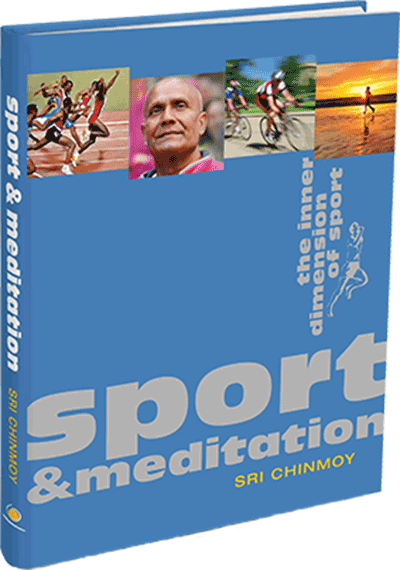
In 2013, after nine years of trying, I felt this was the best chance to finally achieve the goal of winning a national championship. Rather than leave things to chance and hope for the best, I sought to make training and preparation as careful and focused as I could. I also read Sport and Meditation by Sri Chinmoy to garner any spiritual tips for physical self-transcendence. One thing that struck me was Sri Chinmoy’s advice to be in a happy frame of mind. If you enjoy what you do, you gain an added strength.

I tried to improve my physical preparations, and at the same time, tried to be more receptive to the inner strength. I hoped that the intangible inner motivation and inner grace could be the difference in this world of marginal gains.

The inner and outer preparations paid off, and on a cold, wet, windy day I finally finished first. It was great to win, after finishing 4th and 5th on so many occasions.

number-flapping-stang.jpg
The national hill climb championship 2013 - I still had a few problems with proper pinning of number. Photo credit: Cycling Weekly, Oct 2013

In recent years, younger riders have got faster and it has been harder to maintain the dominance of the hill climb season. Despite making great efforts at continued self-transcendence, you can’t always remain the fastest in the country. But that doesn’t bring self-transcendence to an end. The next year, defending the title, I finished 4th, but still felt that in the race I had experienced a form of self-transcendence - pulling out a good performance, doing the best I can. They say finishing 4th is the worst, but I disagree. Getting joy, no matter what the result, feels like a type of progress. (See article: reflections on 4th place)

This year, I tried in different direction. Rather than short ‘punchy’ hill climbs which require fast twitch muscle fibres, I tried my first 12 hour time trial. Despite back pain, I finished 2nd in the national 12 hour championship with 284 miles. The hardest point of the race was at two hours, but I was really committed to finishing the 12 hours - whatever the distance. This helped to relax and get in a flow; for the middle part of the race, I got into a good rhythm. When you think about cycling continuously for 12 hours it seems really difficult, but it was great to be able to do it and find the experience different to what you imagine it would be like.

Next year I hit 40, which moves me into something called a ‘veteran category’. An excuse to go slower. or opportunities for different kinds of transcendence - trying to maintain the form and effort, despite advancing physical years. Sri Chinmoy took up weightlifting in his mid 50s, so there is still plenty of time to do something worthwhile.

Related articles:

  • Tejvan Pettinger - home page
  • The role of genetics - more musing at personal blog


View full article »

My first Audax ride: 35 hours and 600km through the Welsh countryside

By Vilas Silverton
16 June

Vilas Silverton from the Sri Chinmoy Cycling Team took part for the first time in a 600km Audax ride, a long-distance cycling challenge also known as a Brevet or Randonee. Although they are not races, they do have time limits (in this case 40 hours) and require riders to pass through certain checkpoints en route to prove passage. Below is Vilas' entertaining account of what transpired:

vilas-selfie.jpg

The ride started from a small village hall near Tewksbury in England at 5.00am and headed into South Wales before crossing over to the west coast, heading northwards towards the top of Wales before returning back to the start in England. The ride contained 10,000 metres of climbing which, I discovered, is rather a lot!


Before the event I was excited and a little nervous, my longest ride to date had been 220km with Sri Chinmoy Cycling Team colleague Garga Chamberlain, which was made very difficult by poor weather conditions (ie non stop rain, and winds strong enough to blow you off your bike). However, since that ride in February, I had done other long rides that felt much better. After struggling to follow paper maps on my first Audax ride, I quickly bought a garmin which massively cut down the time I lost at road junctions etc where I was not always sure which way to go (directions are not my strong point!). This device had my route loaded onto it, so I could follow a little arrow on the screen which told me what roads to take. 

sea.jpg

After checking all my equipment the week before, studying the route, and carbo loading for 3 days, I felt really thrilled to be able to start at dawn with about 40 other riders on the day itself. To begin with, we rode easily as a pack to the first checkpoint at Monmouth, which was 50 km away and got receipts from an ATM to prove we had got there. I was happy to ride with others at this point, as I couldn’t get my garmin to work at the start.

After the easy first section, we started heading into the hills of Wales where the group broke into pieces and people rode in small groups of 3-4 or just solo. By this time I had figured out my garmin and so was perfectly happy to ride at my own pace. Quite often, this did mean I enjoyed riding in the company of others, but I was also not worried about riding alone.

It rained gently most of the first day but it was warm also, so I rode in shorts, short sleeved jersey, gilet and arm warmers. It was a bit too warm for a rain jacket - for now. My plan was to err on the side of being too warm rather than too cold, as I didn’t want to use up energy by getting cold/keeping warm. In a long ride such as this, I kept the pace very easy on the hills and rode steadily on the flatter sections. This was to keep my heart rate low and stay as far as possible in the ‘fat burning zone’.

In training, I had some difficulty with digestion, and was a bit worried about getting through the event if nothing would stay down. I need not have worried however, and ate well at cafes and supermarkets en route. I also took a number of energy bars etc with me as some sections of the route (up to 100kms) passed through isolated and exposed countryside where there was nothing to eat (unless you are a sheep).

bije.jpg

Around 12.30am I arrived at a control point that had beds and here many riders stopped to sleep. I felt quite good however, and decided to keep going. I did stop long enough for some pasta and a change of clothes (I had sent a bag on ahead). This meant I could change out of my wet shorts and socks - luxury! It also meant I could swap my leg warmers for full length tights for the night although the night time temperature probably didn’t get below 10 degrees centigrade.

I was really looking forward to riding in the night. The roads were very quiet, just a few cars now and then, but as I rode through the darkness, I had owls, bats and sheep for company. I couldn’t see the beautiful countryside at this point but I was happy to keep moving. Having helped at some multi-day running races in the past, I am acutely aware that night time is a special time for doing things. Most people can run or cycle in the day, but if you can forego sleep for a while to achieve an important task, it feels magical to me.

The consequences of riding for 24 hours with no sleep were starting to catch up with me however, as I started hallucinating at around 4.30 am. I saw people walking around in the road and cars coming towards me that did not really exist. I was also having a bit of trouble keeping my bike going where I wanted it to. I promised myself a sleep at the next control.

night.jpg

I was enjoying the night section though, particularly as the weather was dry. However, that changed after a few hours, and all my lovely dry clothes got soaked again, so I sat down on a deserted road, struggled to put on my waterproof jacket, shoe covers and neoprene gloves. About 6.5 hours after setting out from the previous checkpoint, I arrived cold, wet and uncontrollably shivering at the next one, a community centre/village hall in mid-Wales. A nice lady made me the classic dish of baked beans in tomato sauce on toast (she may have been an angel?) however, as my stomach was a bit sensitive, I couldn’t finish it, unfortunately.

Another rider was there too, and a few helpers asked me about Tejvan (Pettinger, Sri Chinmoy Cycling Team hill-climb champion) and his exploits. I was happy to have my mind distracted by other things at this point and very grateful to be wearing Sri Chinmoy’s name on my kit for all to see.

Spotting a blanket in a corner of the hall, I asked to borrow it and wrapped myself up and went to lie down, still wet and shivering. I awoke about an hour later, feeling warmer and better, so I put my wet shoes and socks back on and headed out of the door.

As the last section had been so hard, I foolishly thought the next one might be a bit easier. It was a bit shorter, certainly but the hills were very steep and relentless. They were very small lanes that went straight up hill sides rather than gently curving around. Since 150km however, I had pain in my right knee which meant I couldn’t really put much force through the pedals. As the pain was on the outer edge of my knee, I figured it was just the ITB that was tight and pulling on the joint, so I massaged it at every stop in order to keep moving. I was praying hard that this inconvenience would not stop me riding. I was very grateful that my knee pain would allow me to remember Guru too (Sri Chinmoy also was affected by knee pain during his considerable sporting career). The direct consequence of this situation is that I had to walk up the steeper slopes even though I had low gears on my bike. For a sporting cyclist, this is quite an ignominious position to be in, but here I was, limping up hill after hill in my slippery cycling shoes while pushing my bike. My focus at this time was to keep moving. If I couldn’t ride fast, I would ride slowly, if I couldn’t ride, I would walk, if I couldn’t walk, I would hobble and limp, and that was where I was right now.

At least I didn’t feel tired, the hour nap had done the trick, and I wasn’t cold. These were two big positives. In time, the rain eased, and the kilometres ticked away. Due to the steep, wet and gritty lanes however, I had a new problem, my brake blocks had worn down to such a degree that I no longer had a rear brake and my front was on borrowed time. Thankfully, the last stage of around 70 kms was on bigger, flatter roads that didn’t require me to use the brakes very much.

Before the event, I was concerned that I might not make the 40 hour cut off, but as it turned out, I rode the final stage feeling really good and riding strongly. With most of the ride behind me, I felt able to raise the pace, and gratefully, I finished in 35.5 hours.

View full article »

Sri Chinmoy at Mens Running Magazine

By Tejvan Pettinger author bio »
17 January

About the author:

Tejvan organises short-distance running and cycling races for the Sri Chinmoy Marathon Team in his home city of Oxford. He is also a very good cyclist, having won the National hill climb championships in 2013 and finished 3rd in the National 100 Mile Time Trials in 2014.

mens-running-1.jpg

"Meet the spiritual leader, peace ambassador, runner and
weightlifter who encouraged an entire generation to seek
fulfilment through long-distance running"

Sri Chinmoy - at Men's Running Magazine pdf

Related

  • Mens Running magazine
  • Going for a run around the block - why the 3100 mile race is a race like no other - at Mens Running Magazine
View full article »

Highlights from British Time Trial Championships 2015

By Vilas Silverton
5 January

This video was taken at the British Time Trial Championship, June 2015. The footage was shown on British Cycling Live streaming and also British Eurosport. The event was held at Cadwell Motor Park and the Lincolnshire countryside.


There was a big startlist with other 300 riders, from different categories and many top British professional entering the race.

Tejvan Pettinger of Sri Chinmoy Cycling Team finished 7th, in a time of 1.06. The winner was Alex Dowsett Movistar, who earlier in the year had broken the world hour record.

Top 10 Men

1 Alex Dowsett Movistar Team 01:00:11.13
2 Edmund Bradbury NFTO 01:03:42.25
3 Ryan Perry SportGrub KUOTA Cycling Team 01:04:02.28
4 Matthew Bottrill www.drag2zero.com 01:04:31.50
5 Lloyd Chapman Richardsons – Trek RT 01:05:43.02
6 Ashley Cox CC Luton 01:05:52.70
7 Tejvan Pettinger Sri Chinmoy Cycling Team 01:06:07.64
8 Jason Bouttell Velopro 01:06:15.57
9 Josh Williams Revolutions Racing 01:06:23.50
10 Gruffudd Lewis Pedal Heaven RT 01:06:31.07

View full article »

New Run and Become Store

By Tejvan Pettinger author bio »
10 November

About the author:

Tejvan organises short-distance running and cycling races for the Sri Chinmoy Marathon Team in his home city of Oxford. He is also a very good cyclist, having won the National hill climb championships in 2013 and finished 3rd in the National 100 Mile Time Trials in 2014.


After 33 years at Palmer Street, the successful running shop Run and Become has moved to a new location in the heart of Victoria, London. To celebrate the move to Ecclestone Street, many customers, suppliers and long-time supporters were invited to an evening function to mark the occasion. In addition, Ashrita Furman, the world’s most prolific Guinness World Record holder record, came over from New York to attempt a new Guinness World Record.

outside-store.jpg

Run and Become was founded in 1982, by Ongkar and Vinodini Smith - after their spiritual Teacher Sri Chinmoy suggested they open an enterprise for sporting goods. 1982 was one year after the first London marathon and, in those years, running was very much a minority sport - with no specialist running shop retailers. Over the past 33 years, Run and Become has played an important role in the London and British running community - serving runners with independent service and advice.

Run and Become, also have branches in Edinburgh and Cardiff.

Speaking at the opening ceremony, the current manager, Shankara Smith spoke about the aims of Run and Become, and how it is inspired by the philosophy of Sri Chinmoy. Sri Chinmoy himself was a keen runner, completing many marathons and ultra-marathons during his running career. Sri Chinmoy also taught how meditation and the philosophy of self-transcendence could play a beneficial role in helping the outer running. Throughout the store, there are several photos of Sri Chinmoy, including photos of meeting great running heroes, such as Jesse Owens and Carl Lewis.

don-ritchie.jpg

Don Ritche, Sri Chinmoy, and founder Ongkar Tony Smith from 1982.

The new store

outside-2.jpg

The new store is set on Ecclestone Street, just off Buckingham Palace road - and a few minutes from Victoria train station. A team of talented architects from Czech Sri Chinmoy Centres have helped create a beautiful, light and spacious environment to display the running shoes and clothes.

customers2.jpg

Within the store, there is also a mini running track - ideal for testing out spikes and running shoes. All shop assistants have been carefully trained to help customers find the best running shoes for their needs. In the downstairs floor, the store will also hold related workshops and personal physiotherapy services for runners seeking to prevent and deal with injuries.


Guinness World Record Attempt

ashrita-eggs.jpg
Ashrita Furman sets new Guinness record for flipping egss in a glass, using only breath!

Ashrita Furman sought to break the Guinness World Record for blowing over the most number of eggs in a cup, in a minute. Ashrita was on great form, blowing over 61 eggs within a minute. (the record is yet to be confirmed by Guinness)

egg-blowing-fun.jpg

After Ashrita’s successful record attempt, those spectating had a go for themselves - learning that it was much more difficult than it looked. Some, including the author of this article, took a good few minutes before successfully flipping over one egg.

Run and Become photos


door.jpg

Welcome

run-and-become-sign.jpg

Run and Become

your-running-goal.jpg

Your Running Goal?

inside.jpg

Run and Become
Become and run.

Run to succeed
in the outer world.

Become to proceed
in the inner world.

- Sri Chinmoy

shakara-dipika2.jpg

Dipika and Shakara Smith.


View full article »

A Corinthian Endeavour - Story of the National Hill Climb Championship

By Vilas Silverton
2 November

corinthian-endeavour.jpg

A Corinthian Endeavour by Paul Jones tells the story of the UK National hill climb Championship from 1944 to 2014. The championship holds a unique place in the UK cycling calendar, always being held in the last weekend in October, marking the end of the domestic time trial season. It is a race that has, over the years, attracted some of the top professionals, such as Tour de France riders like Chris Boardman, Brian Robinson, and Malcolm Elliot - but also a breed of specialist hill climbers, such as Granville Sydney and Jim Henderson - riders who are ideally built for racing up steep hills.

In this book, the author Paul Jones, takes us on a humorous and informed journey through the diverse and sometimes quirky nature of the British hill climb season. As the title suggests, Jones is also interested in the amateur ethos and the fact that the race embodies some of the finest qualities of cycle racing.

hill-climb-agony.jpg

For the uninitiated, Jones explains some of the fascinating aspects which go into a successful hill climber - a high power to weigh ratio, an ability to do repetitive, lung bursting hill climb intervals, meticulous attention to stripping weight from his bike, and the ability to ride at the very limit of physical and mental endurance.

The Stang

2013_HC_Champ_Pettinger2-larry-hickmott.jpg

Within the book, Jones devotes a chapter to Sri Chinmoy Cycling Team rider, Tejvan Pettinger. Pettinger won the event in 2013 - after ten years of trying and near misses. Jones examines those 10 years of near misses that characterised Tejvan’s previous attempts to win the title, but also has a look at the spiritual aspect of Tejvan’s cycling.

Writing in the book:

“And yet, there is another layer of spirituality to Pettinger. He doesn't hide it, it's emblazoned across the jersey of the 'club' he rides for, Sri Chinmoy CC (sic):” “p253

Quoting Pettinger in the book, he says:

“The spiritual life has to come first, but fortunately, cycling is very complimentary. (though) I never race on wednesday evenings because of meditation. I could never be a professional.”

tejvan-velo-shooter3.jpg
“I’m not the kind of person who needs to win for my self-esteem. I just enjoy cycling and I enjoy cycling hard. The motivation to try to win the championship - it's more than an ego thing, it's an opportunity to achieve something; there is an inner element to it. Sri Chinmoy's philosophy is that a big thing is self-transcendence, trying to go beyond your limits, spiritually, mentally, physically. Trying to go faster is part of spirituality, of meditation. If you can be happy, in a good consciousness, you can bring a lot of energy to the fore. When you're abut to race it can be easy to be nervous or think about your competitors. That's an important challenge: to be in a better consciousness." p.254

Talking about the mental aspect of racing:

"Often when I'm doing a race," he says, "I'm trying to keep my mind quiet and not think. To help that I repeat a mantra, like 'Supreme'. It's just a mantra I use in meditation. I don't want any thoughts going through my mind, only the mantra, inwardly. The best experience is when you're in the zone, you've not got that 'did I go off too hard, too early, that spectator's looking at me funny.' You're absorbed in the effort. That's the real buzz of hill climbs; you can get into this state which you very rarely get into; you're so beyond the limit, you're way beyond your ordinary experience and it has some parallels to meditation, because in meditation you're trying to get away from your mind and the thought, everyday world, and here you're doing it in a very real way because you're pushing yourself so much. And it's torture physically, but you get some kind of joy from it, and you look back and you think, 'Wow, that was a real three minutes. I really lived in that three minutes. I don't quite know what went on but I was on the edge and experiencing something different.'

Related

  • A Corinthian Endeavour at Amazon.com
  • A Corinthian Endeavour at Amazon.co.uk
  • Read Tejvan's review of A Corinthian Endeavour on his cycling website
View full article »

Karteek Clark swims English Channel for the eleventh time, July 2014

By Prachar Stegemann
30 July

July 30, 2014 - Karteek Clarke, member of the Sri Chinmoy Marathon and Swimming Team swam the slowest and toughest of his 11 Channel crossings on 30 July (19 hours and 1 minute). He is indeed a champion of champions. Looking at the map of his route, you’d think he really didn’t have a clue where France was, or else was getting awful advice from his crew. This drunken arc is all the work of the tides: his swim was made all the more challenging for falling on a Spring tide, the strongest and most wilful of ocean currents.

karteek-map.jpg

Imagine swimming in a pool on the roof of a building. While you are swimming, King Kong picks up the building, puts it onto a gigantic swing, and starts rocking the swing through an enormous arc in the sky. You think you’re swimming in a straight line which you sort of are but your position on a GPS goes all over the place. For the whole 19 hours, Karteek was swimming straight towards France, yet the tide ensured his predominant motion was always sideways. There were times when – even though Karteek was always swimming forwards and towards France due to the tide and the curvature of the coastline, he was actually moving further away from the shore.

karteek.jpg
Karteek takes a feed, watched by his helper, Devasishu Torpy.

Don’t even start to imagine what this can do to your mind and your will! Now imagine that the ‘pool’ you are swimming in is actually a huge washing machine or butter churner (oh yes, and it’s also very, very cold in there). No two strokes you take are the same—one moment you breathe to your left and a mammoth wave smacks your face; the next you stroke to the right and flail in thin air at the edge of a heaving precipice. Especially at night, your universe above, below and all around – is a constant unstable relentless surging disarray. Only the shore is certain: it can be seen, always apparently just ahead (at night you see the lights) — but where and when it will be reached is not worth guessing at.

To me, the most impressive and amazing thing about Karteek’s performance, is that he never once – not once – asked where he was or how far or how long he had to go. That seemed almost irrelevant. Yet how the mind – in the midst of constant sickness, disorientation and discomfort – must have been screaming to know “How far??” For hour after hour after hour, he could see the shore ahead. As the sun set, France was looming – and all through the night, the lights were just there before us – though day had dawned before the pilot finally declared the water too shallow for the boat to proceed and bid Karteek to swim ashore alone. 


View full article »

Multisport Events - Bristol 2025

By Garga Chamberlain
9 November

In 2025 we are planning to stage three multisport events in the Bristol area.

SwimBikeRun-MINI DUATHLONS - our popular series of Run/Bike/Run events at Tockington Manor School is all set to go ahead on three dates in 2025, now with a choice of distances and the price back down to ten pounds - for details see the event page. The March and September Duathlons will be standalone events while the May race will be held as a Duathlon Wave alongside our Try-a-Tri / Triathlon.

SwimBikeRun-MINI "TRY-A-TRI" TRIATHLON - aimed at beginners / first-time Triathletes, this SwimBikeRun-Mini event will include a 200m swim in a heated pool, 10km flat-profile cycle ride on lanes around Tockington and Awkley and an easy 3k run on the sports field opposite Tockington Manor School. Thanks to support from British Triathlon it only costs twenty pounds to take part - entries are limited to no more than 80 participants though so book early to avoid missing out! Entries are open and the proposed race date is Monday 26 May 2025 - you will find full details and a link to the online registration, when it opens, on our event page.

All these races are beginner-friendly, but also ideal for experienced triathletes looking for race practice. Click on any of the links above for more information about the course and how to enter our events online.


View full article »

Self-Transcendence

By Garga Chamberlain
10 September

Our club's founder, Sri Chinmoy, will forever be associated with the words "Self-Transcendence". In his own words:

"We compete not for the sake of defeating others, but in order to bring forward our own capacity. Our best capacity comes forward only when there are other people around us. They inspire us to bring forward our utmost capacity, and we inspire them to bring forward theirs. That is why we have competitive sports. The seeker-athlete never tries to compete with others, but only tries to transcend his own capacity."

This is the philosophy behind all our races, in the UK and throughout the world, from 1 mile to 3100 miles!

Self-Transcendence is all about pushing beyond our self-imposed limits and discovering what we are truly capable of. The Sri Chinmoy AC is primarily a running club, but members also take part in cycling, swimming and multisport events - all motivated by the inspirational philosophy of our founder Sri Chinmoy - his writings on Self-Transcendence can be found in our RESOURCES section.

Below are links to some sites recounting the experiences of club members - from beginners to world record holders!


Sri Chinmoy Swimmers

Ashrita Furman's World Records

Sri Chinmoy Cycling Team

Garga's Race Page

Sri Chinmoy AC Oneness Races

View full article »

Ed's Race Report

By Garga Chamberlain
27 March

Cirencester Duathlon Feb 17th 2008.

You could say that this event started when my Sri Chinmoy Cycling Team colleague Roger brought it to my attention in late 2007. It involved running two miles along countryside trails, followed by ten miles of mountain biking and then two more miles of running. Organised so that the different sections followed each other consecutively, the race had the feel of a triathlon less the swimming. I foolishly believed that I would be in good enough shape from a winter of cyclo cross racing to put in a respectable performance. All I had to do was increase my running training from 'a little' to 'a bit more than a little' and I told myself that I would be fine.


/uk/images/ed08.JPG


My preferred tactic of getting an early night before race day didn't quite happen as I was still trying to get my 20 year old mountain bike working at midnight, the day before the race. At a certain point, with tiredness overtaking me, I resigned myself to not getting everthing perfect (I couldn't get half my gears) but at least the wheels were round and the brakes worked.


Sub-zero temperatures meant a little gentle coaxing was needed to get the car (and driver) going come race day, however, a radiator fault meant that the car was overheating despite driving very gingerly to the event...with time ticking away and the guage hovering in the red all the way, the venue proved mercifully easy to find without needing to call for assistance. One of the benefits of the dodgy radiator was that I had the heaters on full so I was beautifully warm for the race start.


As running is definitely not my strong point, I decided to set off steadily until my legs (and body) became accustomed to the effort. The start was heralded by a rather unusual noise not unlike an old war-time claxon. My interpretation of steady was not shared by many of my fellow competitors and I was quickly swamped from behind as people bounded off into the frosty morning leaving trails of breath like many little steam trains. After a while I wondered when my legs would become comfortable with the running and allow me to stretch out a bit. Unfortunately, that never actually happened and my cyclists' running style stayed with me throughout.


I was very impressed with the general good will in the bunch, a bit of good-humored banter and words of encouragement to friends and strangers alike. How different to a typical bike race I thought! At some point I realised that I was coming back to a section of the course that I recognised and had the sinking feeling that comes with the realisation that I had only completed one lap. 'That's a long mile' I thought to myself, looking at my watch, I wished I hadn't. I tried to encourage myself by reminding myself that all I had to do was hang on for another mile before I could transfer to my favourite discipline, the bike.


/uk/images/trans08.JPG


Through watching triathlons before, I was aware of the importance of changing quickly after one section before starting the next. As this event involved just running and cycling, I was running in my cycling clothes with trainers for the first section. For the bike, I changed my shoes for ones that clip onto special pedals and put on my helmet, which I would be glad of later. As I was so shattered from the running, I treated myself to a few leisurely gulps of sports drink before setting out on my bike.


Cycling out of the transition area was such a nice feeling for me, my legs were no longer struggling to maintain a stifled plod but could spin round lightly with an ease of movement that had me passing people continually. The course started as hard frost but changed through the race as the winter sun and the action of many bike tyres loosened and melted a top film of mud that proved trecherous to many. People were bouncing around one minute as the substructure of the ground remained hard and frozen before sliding uncontrollably when they hit a patch of the soft stuff.


Having some mechanical trouble in the first lap of the bike section, I was determined to make my second lap better (ie faster). I even wondered how far ahead Roger was and if I would see him. Unfortunately, while flying down one section of the course I hit a patch of softer ground and my front wheel took a different course than the one I was planning on taking. First of all I remember going sideways, then down then up and finally, thump! landing square on my head looking at a muddy field the wrong way up.


/uk/images/edud.jpg


It's funny how things work when you're down. I knew I'd hit my head pretty hard as I felt the force travel down my kneck. I also felt pretty winded and a little sore. But my immediate thought was to clear the track for other riders behind me. I needn't have worried too much. It seemed like every other person was doing the same as me and doing a spot of soil sampling when they should have been riding. I was touched by the number of people asking if I was alright. having reasurred them that I was, I watched them go careering off into the distance.


After remounting, the remainder of the bike section was thankfully uneventful. I had no more offs, but saw plenty. In fact, at one point the course was littered with riders who were not actually riding. Many were trying to encourage mud-clogged wheels to turn again, some were pushing and some were going home. The course deteriorated further as the race went on. Rocks and roots became exposed which were very bumpy in places, the mud got stickier and slippier and the grass sections offered competitors new ways to go sideways while trying to go forwards.


I had long since worried about my overall placing in the race. I knew I'd lost many places in the run, and had then gained back many on the bike section only to loose them again when I fell off. I lost even more when I couldn't un-jam my chain at one point and in a fit of rage threw my bike into a field. I only had to go and get it back and carry on. The final two mile run was tough although I encouraged myself by saying that I'd managed to keep going and not walk (although I came very close).


At the end, I met up with Roger who had already finished and was looking happy enough for both of us!. With the sun shining, it actually felt quite warm. We celebrated with a flask of hot tea and half an energy bar each, a perfect post-race picnic that kept us going before a 'team lunch' courtesy of a road-side service station. My initial reaction of 'never again' softened into an enquiry about when the next race would be...


(NB. Roger's race report is on his web site / blog)

View full article »

Christmas Cracker 10k December 2006

By Garga Chamberlain
28 January

Mark's account of a classic race that also saw Fran and Amelia competing for the Sri Chinmoy AC

/uk/images/westonview.jpg

For the past three weekends it had been wet and windy and I was preparing myself for the challenge of running head long into a stiff wind on Weston's famous promenade. However, on the day you could not have asked for better conditions on this marvellous flat 10k course. The sky was blue and the sun was golden, and pleasantly mild for this time of year – the impact of global warning is becoming all too obvious.

It felt like spring and a spring was certainly in my step. This was to be my first 10k race in over 20 years. For a long time I had shunned competitive racing due to a heady mix of numerous long term injuries, lethargy, lack of confidence and lack of enthusiasm and lack of ambition. When I was young I was highly competitive, and then I made the decision that I was to be one of those runners that ran just to keep fit, to supplement by footballing ambitions. You had to be quick and have plenty of stamina to survive pub league football and the many 5 a-side games I played. Never that brilliant, just average really – my team mates called me ‘Running Man'! I never stopped running around the pitch, and no loss cause was ever†¦ well, lost.

Anyway, back to the race. I made my way to Weston College where other runners congregated to change. One of the best aspect of this race is it is a fun race, where the organisers encourage competitors to dress up in fancy dress, and it is mandatory for every runner to wear at least one piece of Christmas tinsel. It is an end of year get together and an opportunity to run in a festive mood and raise some money in the process.

As I got changed a man in a ‘60s psychedelic cat suit caught my eye. You couldn't exactly miss him. Will the cat suit catch on, who knows? Perhaps it's good for post race recovery, like those Skins fabric that assist muscle recovery. Every runner thinks any little advantage may help. As you would expect there were plenty of runners wearing Father Christmas hats. I didn't wear one – too much drag factor.

I made the short distance to the start on the beach under the pier where those in fancy dress were being judged. As you would expect there were fairies, elves and Santa Claus. The huddled hundreds with colourful tinsel flowing got ready to start.

In fact 1,254 runners actually finished - see results at:

Wyvern 10k Results Page

Wyvern 10k Gallery

I was content to start in the middle of the field and take it easy. At 10.00 the gun exploded and wet sand under foot I jogged off to see the fast, serious runners sprint like gazelles across the beach. A few hundred meters and I was in carnival, fun run mode, and still even coming up to the 1k mark. Then I had to remind myself that this was a race and not one of my leisurely runs, and from first gear I stepped up to third gear and quickened my cadence across the somewhat soft sand. Running into the sunlight, and feeling the rays on your face with the light breeze and the smell of the sea reminded me so much of running back in Cornwall. As I sped up I passed Amelia (Sri Chinmoy A.C. London). I would see her again later at the end of the race.

The first part of the course is on the beach, the larger middle section along the promenade and local roads, and the final section back on itself onto the beach again.

Wyvern 10k Gallery

Over half way into the race and I was motoring on nicely and on target to get below 40 minutes. At one point I looked at my watch and believed I could get under 38 minutes. I continued to make good progress and throughout the whole race no one passed me. I think that was a sign that I started too slowly. Running the final stretch back on the beach was a brilliant finale, if a little but soft under foot and heavy on the legs, but I was pleased to have run the last 2k very strongly. I achieved my target and got under 40 minutes with a time of 39.30.

I saw Amelia after the race and she gained a PB of 44.53, whilst Fran, unfortunately got a personal worst, but I think she was suffering from a bad cold.

This was a great reintroduction to 10k racing and the organisation was slick and faultless. I felt a real sense of joy and achievement to have participated. It is certainly a race I will mark on my calendar for next year. Hopefully more runners from Sri Chinmoy A.C. will participate next year.

So inspired by this race and in the knowledge that with some serious training I can run faster, I looked for another 10k race to run in. And, my next race is the Mounts Bay 10k on 4th February 2007 down in Marazion, Cornwall; not a stone's throw away from the town where I grew up, and where my parents still reside, Penzance. Let's see if I can self-transcend the time of 39.30.

View full article »

A few words about Ongkar Tony Smith

By Garga Chamberlain
19 October

Ongkar Tony Smith

ongkar262.jpg
 

As most of you know our good friend Ongkar passed away in February of this year.   Many of today's runners who have run at Tooting before will fondly remember his total commitment in making sure that this race worked like clockwork.

With his usual smile and humility he would always say that the event worked because we had a good team making it work.   However, someone had to recruit and motivate the team to share the vision he had of putting on a great 24 hour race.

Having known Ongkar for the best part of 28 years I can tell you he wouldn't want a race held"in memorium" or for us to feel sad today, whether you knew him well or had never met him.   He would want us to be happy and"get on with it"! So let's make it a real celebration of the spirit of ultra-running and encourage each other to bring out some good performances.   That's what would make him happy!  

He used to feel anyone embarking on a 24 hour event was setting out on a journey of two parts.   The outer race of laps, numbers and figures which fade away; and the inner race of dreams and determination, highs and lows and the bad patches and good spells.   Ongkar could see and feel what the runners were experiencing because he had been there himself.

So for those of you that knew him, remember him with a smile as you circle the track.   I'm sure he will be here in spirit today keeping an eye on us all with that huge smile he always had.

Thank you Ongkar Tony, you made this race happen!
Thank you Shankara for continuing the tradition!

Tarit Adrian Stott

View full article »

Ironwoman

By Garga Chamberlain
7 September

Agnes from the Sri Chinmoy AC in Edinburgh recalls the amazing journey of her first Ironman Triathlon - completed in the debilitating heat and humidity of Malaysia!

"Taper, taper taper." I recalled Tarit's advice. Do you the meaning of the word taper? Rest for 3 weeks before the race. Believe me, your body will be grateful to you!

Here I am on the day before the race, muscles soft like a jelly. Where did all the countless hours of training disappear? I could not feel even one moment of the hard work in my legs any more. I guess the regular massage, healthy nutrition, Megabhuti's liver cleansing once a month, and a taper did the trick. My longest training ride was very easy - forty three miles along the race course on Sunday a week before the race. The beauty of the nature was stunning. Sandy beaches, Malay villages, palm trees, small islands, I was really lucky to be here in this heaven for more than two weeks with plenty of time to acclimatise and relax.   Luckily for me, no big hills this year! The bike course has been changed. On Friday two days before the race, Andreas from Switzerland, Robert from Czech Republic, Linda from Hungary and myself moved to Kuah nearer the race start. I left behind my dear room-mate Julia from Oxford, who was very patiently sharing a room with me, my bike, and all the race gear which was lying just about everywhere.

After Neil almost crashed into me on the bike during the Portobello Sprint Triathlon, because I could not see him from my pony tail, I knew the biggest and only sacrifice had to be done - I had to cut my long hair for safety reasons. Julia was happy to do that.

So finally I was ready for the start. That day I was hundred percent sure that this race was nothing to do with me, but was 99%   God's grace and 1% help from all my dear friends and family who coached, massaged, advised and encouraged me and who fixed my bike! All the credit goes to them.

As the party was on Friday afternoon I did not feel like going anywhere. Finally after Robert's third phone call I made it out from my room. Linda, Robert and myself arrived at the pasta party - once there I was really grateful for this. It was so inspiring to chat with all these great athletes. First we met Roger Price from Houston - it was his 27th Ironman. Diane and Debbie were excitement for my first race - we all exchanged really nice and kind words of encouragement during the race.

Next day. Finally we ended up at the same table as Zsuzsanna Harsanyi, Petr Vabrousek and famous Jason Shortis. Zsuzsanna is a Hungarian professional. She was second, her time 10:16:24. She is sweeter than the sweetest. And none of the photos is doing her any justice. She is much, much nicer. We spent hours together chatting about everything. Petr is a Czech professional. He was fourth in a time of 9:00:06. He is also extremely kind. He stopped during the race to asked a Danish guy who was struggling if he was ok. A real sportsman. We were all totally impressed by Jason - he was first in 8:36:33. He was racing at our Sri Chinmoy Triathlon Festival in Australia (He is Australian). Eventually all of them were holding the torch, smiling for the photos, it was a great evening.

The day before the race we had the bus tour on the course, the race briefing, and the bike and gear check-in. I managed to get myself together and concentrate on sorting out my stuff, and not forgetting anything from my cycling and running kit. I was a bit nervous but not for long. We went for a nice meal with Linda, who decided to stay longer and help on the race. That was absolutely terrific. While Linda was trying to get some bananas for me from the night market, I went to the race info once again - I was feeling OK. I read the "Spiritual meaning of the Triathlon" by Sri Chinmoy and a card from my dear friend Alison (Ironman New Zealand finisher) before I went to bed. Alison's message: "All this time training and waiting and now the moment is near. Put your foot on the accelarator and get into third gear. Good luck in Langkawi. Put all your training to good use. But most of all enjoy the experience, you will love it."

D-DAY

The Ironman Langkawi begins with a two lap swim in Kuah bay, which starts and finishes alongside a giant eagle statue. The three-loop bike course is fairly flat and is followed by the four lap run course. Total swim distance is 2.4 miles followed with bike ride of 112 miles and finished with a 26.2 mile marathon run.

Dawn. No thoughts. No feelings. No emotions. I just exist. I knew I am where I am supposed to be doing what I am supposed to do. First time in my life, I really trained for a race and I could feel why Sri Chinmoy puts such an emphasis on importance of physical fitness. I experience how does it feel being surrounded with healthy, fit bodies, focussed minds and determined vitals. It was an overwhelming, pure and powerful energy. I was all gratitude for the privilege to make it to the start line. All of us, the pros and the newcomers, had the same goal - to transcend our own limitations. The goal of Self-Transcendence.


Three hundred athletes from thirty six countries started together in the warm waters of the jetty. It was fantastic. I really enjoyed the swim. I had time to bask in the sunshine and send my greetings to Surya the Sun-God who would accompany me today, the whole day long. Well my first shocking experience was when after the second helf point turn I noticed that I needed 47 minutes for one quarter of the loop. God, I won't make it within the cut-off!   I will have to stop the race! Cut-off time for the swim was two hours tenty minutes. In a pool my time was tragic, very slow, 1:36. Probably the current was the reason for my even slower swim in the open water. I was paddling as fast as I could. The way back took only 17 minutes with the help of the current. I was out in four hours three minutes, and very happy that the first task was over. I was still in the game.


Finally on my bike, everything went along very well in the first lap. I was fascinated with Chris Lieto's speed - Bryan Rhodes and Jason were far behind him on the bike. Rebecca Preston was the first girl - it was amazing to watch the pros in action. I saw Robert who was going very fast - Andreas was enjoying himself, smiling and asking how am I, it was nice to get some extra encouragement.

The disaster struck in the second lap - there was no water at the aid stations - my mind was in a state of complete panic. On the next aid station I wasked for water, they said "it's water". Great! Relieved. I poured so called water on my head - it was an energy drink. My hair, glasses, jersey, bike, everything was sticky. I would need to pedal for five or six more hours in 40 degrees heat without water. On top of all this my gear shifter refused to move. LAter on Sean in the bike shop told me that the cable probably got stuck. I felt totally helpless. The ambulance was passing with the fastest speed past me with the sirens on. I saw a few athletes lying on the grass. My body was fine but I started feeling dizzy from heat and lack of water. Suddenly I remembered Scott Balfour's advice - "stay calm whatever happens" - so I kept on repeating this. I was so grateful to him for all the advice, coaching, inspiration. He did Kone and other Ironmans - he's world champion in his agegroup, and Scott shared his top secrets with me - "stay calm whatever happens".


A few tears were rolling down my cheeks when I reached the Kali Temple - Kali is my favourite Goddess. I prayed to her, "Mother..... please don't let me die here, please save me". Mother Kali listened to my prayers - from that moment on my gearshift was working. then we had water at all the water stations.


I was pacing myself on 14 miles per hour on the bike, so finally I finished the bike just before the cut off time in 10 hours 24 minutes. Cutoff was 10 hours 30 minutes. I was delighted that I could walk after more than eight hours in the saddle. At this moment I knew I would finish - I had six and a half hours for the marathon. One and a half hours each lap and thats it. I changed slowly , realising that my legs and arms were completely sunburnt. I guess the girls did not put enough sunblock on me after the swim. Soon I had a high fever, but kept on running. I did not want to end up in medical in case they told me to stop. I was so happy to see the others who were struggling on the run - some of them were already finishing. It was just great to have all these people running there on the running loop. I was just copying others - they all had ice cold sponges on their neck, chest, shoulders - so I soon looked like a body builder with all the sponges under my jersey. I was soaked but still I felt I had a really high fever. I started getting well-known muscle pain in my quads. Bioplasma, arnica and energy gels; I stuffed all these in my face with hope to get over it. And then I remember the verse from Sri Chinmoy's triathlon song - "I run with the smile of the beyond" - the whole song is:

"I love my   great triathlon, it shows my heart-gold-vision-dawn, I swim in the sea of silver light, I cycle along the road of gold delight, I run with the smile of the beyond, my inner cry God-treasure-diamond"

So I started smiling even more, I started chatting with everybody. In the fourth, final leg I had my own team - we were all running together it was just great. How I wished that everybody would finish.

I had the greatest cheering crew - many Hungarians like Linda stayed over in Langkawi: Piroska, Tamas, Andrea, Jozsi, Laci and the Ironman finishers Andreas from Switzerland and others who waited for me at the end.

Just before the finish, Linda gave me the Harmony Torch (see www.worldharmonyrun.org - Ed.) it was great to run with the torch through all the crowd, it was so beautiful. The flame was really nice, big, and you could really see the flame from far away in the dark night. I was just so happy. A few athletes came to me after the race and thanked me for the moral support. I felt really honestly privileged to be a member of the new world - the world of Ironman and Ironwoman. People with iron bodies, oneness hearts, sweet smiles.

My family had a most exciting day, waiting for the news, results and pictures on the web site. They were all so happy to see me smiling in the first picture of the second bike lap. My mum wrote: "Daughter, you know very well that I don't fancy all these stupid races, but this was really something special, I am really proud of you."

I would never even make it to the start without the help and inspiration of all these people. Tom Chambers, representing GB in Olympic Distance   Triathlons, was one of those who gave me the starting kick. At that time, in the months after my dearest cousin's passing, I didn't want to run or swim, didn't even dare to buy a bike, and at that time one day he came to the shop and reminded me that I said at the beginning of January that I would like to do a triathlon. He said "I bought three pairs of shoes - and you didn't do any triathlon?". So at that moment something just clicked in me - I knew that I had to do something with my life and I knew that Milan (my cousin) would be proud. The very same day I bought a trainging diary and the very same night I wrote my training schedule and on Monday I bought my bike and this is how I started - very, very, slowly and steadily - crawled - all the way to the finish line in Langkawi!

Thanks to you all without whom this dream would never come true, and most importantly gratitude to my teacher Sri Chinmoy for his blessing and his smile - full of joy and pride.

Agnes finished the Langkawi International Ironman Triathlon in a time of 16 hours 28 minutes, the cut-off time was 17 hours.


View full article »
More articles under Inspiration »

Books and inspiration

Sport and Meditation
Unlock the inner dimension of sport...
more »

Inspiration

main page »

More in this section

main page »
70th Anniversary of First Sub-Four Minute Mile
Staying Fit into Old Age - Centenarian Decathlon

Stories from around the world

Sri Chinmoy Cycling Team
Sri Chinmoy Cycle Challenge 2026
3100 Mile Race
3100 Mile Race Course: A Year in Motion
United States
Seattle 7 & 13 Hour Self-Transcendence Races
United States
3100 Mile Race 2026 - List of Entrants
Australia
Melbourne Sri Chinmoy Running Festival
Latest News
SRI CHINMOY 5K - Scottish Championship 2026
Bulgaria
Ten Runners Reach 1000 km (620 miles) at the Recent Sri Chinmoy 10&6 Race in Sofia

About us

  • About the Marathon Team
  • Sri Chinmoy, Team Founder

Our races

  • View all events

Results

  • Previous races
  • Worldwide results
Global homepage »

Country Websites

  • W.Europe
    • Austria
    • Finland
    • France
    • Germany
    • Great Britain
    • Iceland
    • Ireland
    • Italy
    • Netherlands
    • Norway
    • Portugal
    • Switzerland
  • Central & E. Europe
    • Belarus
    • Bulgaria
    • Croatia
    • Czech Republic
    • Hungary
    • Latvia
    • Macedonia
    • Moldova
    • Russia
    • Serbia
    • Slovenia
    • Slovakia
    • Ukraine
  • N. & S. America
    • Brazil
    • Canada
    • Guatemala
    • United States
  • Asia
    • Japan
    • Mongolia
  • Oceania
    • Australia
    • New Zealand

Other sites

  • Sri Chinmoy Cycling Team
  • SCMT Channel Swimming
  • SCMT Climbing
  • 3100 Mile Race

Popular Pages

  • 3100 Mile Race
  • Recent media coverage
  • History 1977-Present
  • Our members
  • Privacy Policy
  • Impressum
  • Privacy policy
  • Cookie settings
  • Log in

Contact Information

Sri Chinmoy Marathon Team
Creative Commons License

Except where explicitly stated otherwise, the contents of this site are licensed under a Creative Commons Attribution-NonCommercial-NoDerivs 3.0 Unported License read more »

SriChinmoyRaces.org is a Vasudeva Server project.